Navy League Panama's
oldest member
Honoring a Legacy of Historical Inquiry: David Richardson Receives Doctorate for Contributions to WWII Historiography
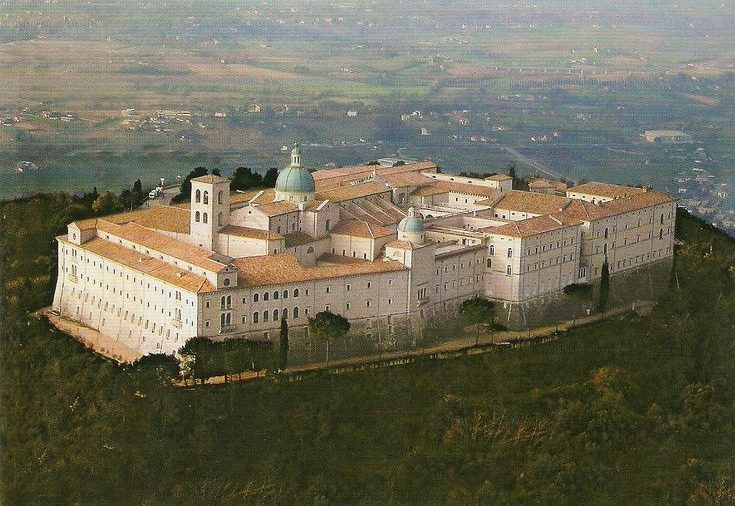
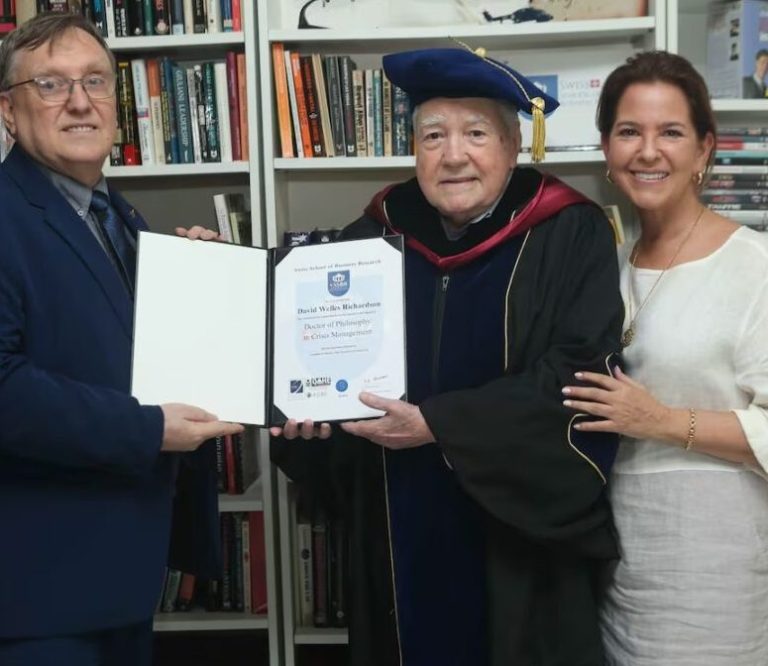
The Navy League Panama's oldest member, at the distinguished age of 89, David Richardson Pacheco Amador, a dedicated researcher and writer, has been awarded the Doctor of Philosophy in Crisis Management by the Swiss School of Business Research (SSBR). This prestigious recognition acknowledges his exceptional contributions to the study of the Battle of Monte Cassino, one of the most contentious and strategically significant battles of World War II.
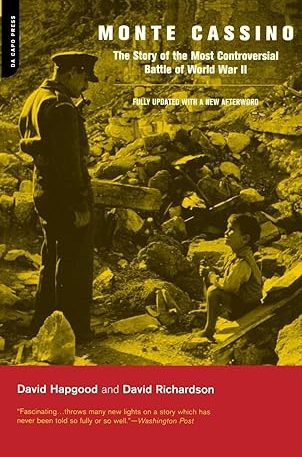
The ceremony, held in an intimate and dignified setting at the residence of Dr. Stephen Harrison, Dean of SSBR, celebrated Richardson’s extensive academic and investigative work. His life’s research into the Monte Cassino battle, which culminated in the publication of the highly acclaimed book “Monte Cassino: The Story of the Most Controversial Battle of World War II” (co-authored with D. Hapgood), stands as a testament to his relentless pursuit of historical truth.
A Life Dedicated to Knowledge and Exploration
Born in New York City in 1935 and later raised in Panama and the United States, David Richardson Pacheco’s life has been one of intellectual adventure and unwavering dedication to research. His career spanned multiple disciplines, from military service and international business to teaching and journalism. However, it was his 12-year-long investigation into the destruction of the Monte Cassino Abbey—driven by a lifelong curiosity sparked by a news article—that shaped his academic legacy.
During this period, Richardson conducted hundreds of interviews with individuals who played pivotal roles in the battle, including Allied and German officers, soldiers, intelligence operatives, local residents, and Vatican officials. His research, an extraordinary effort in historical documentation, revealed critical insights into military decision-making, the impact of war on cultural heritage, and the broader geopolitical consequences of the battle.
A Life Dedicated to Knowledge and Exploration
Born in New York City in 1935 and later raised in Panama and the United States, David Richardson Pacheco’s life has been one of intellectual adventure and unwavering dedication to research. His Great Uncle, Manuel Amador Guerrero (30 June 1833 – 2 May 1909), was the first president of Panama from 20 February 1904 to 1 October 1908.
David's career spanned multiple disciplines, from military service in the U.S. Air Force and international business to teaching and journalism. However, it was his 12-year-long investigation into the destruction of the Monte Cassino Abbey—driven by a lifelong curiosity sparked by a news article—that shaped his academic legacy.
During this period, Richardson conducted hundreds of interviews with individuals who played pivotal roles in the battle, including Allied and German officers, soldiers, intelligence operatives, local residents, and Vatican officials. His research, an extraordinary effort in historical documentation, revealed critical insights into military decision-making, the impact of war on cultural heritage, and the broader geopolitical consequences of the battle.
Recognizing Excellence: The PhD by Portfolio at SSBR
Richardson’s doctorate was earned through SSBR’s innovative PhD by Portfolio program, a unique academic pathway that recognizes the intellectual contributions and research efforts of professionals with a wealth of pre-existing work. This program enables scholars, executives, and experts to achieve doctoral recognition based on their career-long research, publications, and practical expertise.
By submitting his book, supporting documentation, and an updated postscript analyzing newly uncovered information about Monte Cassino, Richardson demonstrated the meticulous, evidence-based research that defines doctoral-level scholarship. His work exemplifies the very essence of SSBR’s commitment to academic excellence, real-world impact, and lifelong learning.
A Lasting Academic Contribution
The private graduation ceremony not only honored Richardson’s historical expertise but also celebrated his resilience, intellectual rigor, and passion for truth. His work continues to shape discussions around historical memory, military ethics, and crisis management in wartime.
David Richardson Pacheco’s recognition serves as an inspiration for future scholars who seek to bring historical clarity, integrity, and depth to their fields of study. His doctorate is a well-deserved acknowledgment of a lifetime of research that has left an indelible mark on World War II historiography and beyond.
Book Review: Monte Cassino: The Story of the Most Controversial Battle of World War II by David Hapgood and David Richardson
Aenean leo ligula, porttitor eu, consequat vitae, eleifend ac
This volume stands as a masterfully researched and deeply insightful account of one of the most complex and debated campaigns of the Second World War. Hapgood and Richardson combine meticulous archival work with vivid storytelling, offering a balanced and humanized portrayal of the struggle for Monte Cassino—a battle that symbolized both the strategic imperatives of war and the tragic cultural costs of conflict.
The strength of this book lies in its breadth of research. Drawing on military records, first-hand testimonies, and perspectives from both sides of the battle, the authors reconstruct events with precision and fairness. They highlight the military decision-making, the political pressures, and the human dilemmas faced by commanders, soldiers, monks, and civilians alike. Particularly compelling is the nuanced examination of the destruction of the abbey, which reveals how questions of "military necessity" and cultural preservation collided under the most difficult circumstances
Beyond its historical value, the book remains profoundly important today. Monte Cassino was not just a military stronghold but also a cradle of Western monasticism and culture, and its story speaks to the timeless tension between safeguarding human heritage and confronting the brutal realities of war. The authors remind readers that history is never merely a matter of strategy or dates, but of values, sacrifices, and choices that resonate across generations.
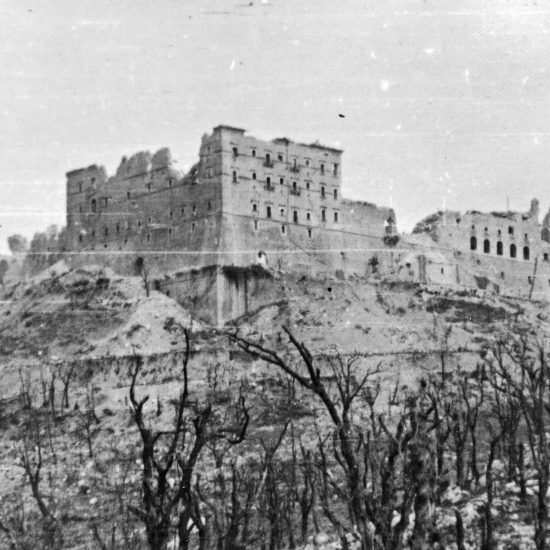
Lorem ipsOn 15 February 1944, 255 aircraft dropped a total of 576 tons of high explosive on or near the monastery.